
We as product manager are well tuned with doing a market read, determining the unmet needs of the market and then getting someone to build products that will satisfy the need.
But there is an important trap that product managers should avoid. History is full of examples of products that fell into this trap. You want to build products that customers will BUY and not JUST LIKE. You could build a product that satisfies the unmet need in the best possible manner, but if it is not something that the customer is willing to pay for, you are out of luck. Your product will languish on the shelf and it will join countless number of other products that have met a similar fate.
We have four different scenarios of Like vs. Buy as shown below.
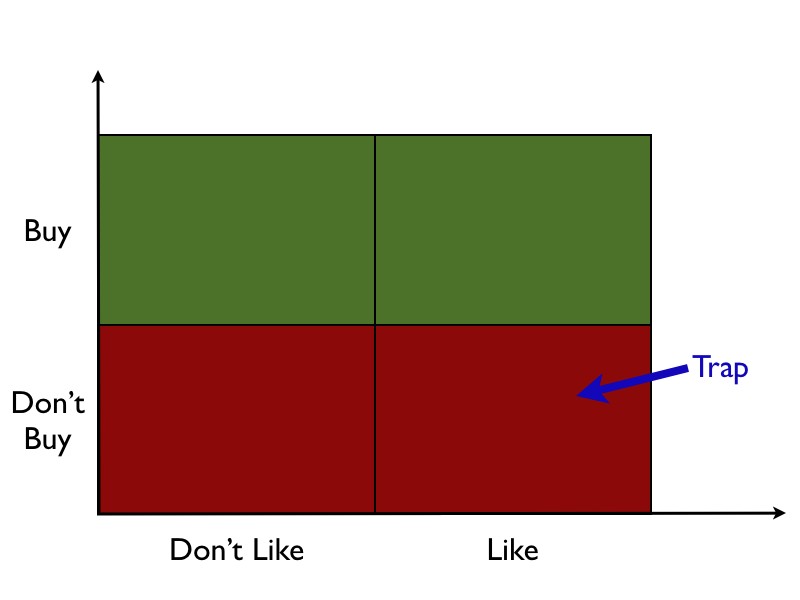
Obviously, the two categories you want to avoid are the red ones and the places where you want to be are the green ones.
You may wonder how you could ever make a customer buy a product that he does not like – there are many classes of products that fit the bill here. For example, insurance products – not that I like them, but I have to buy them – isn’t this such a sweet category to be in? Other examples include anything related to taxes (Turbotax for example), funeral planning products (that one needs no explanation) etc.
The biggest trap among all this is the Like and Don’t Buy category. Lot of customers may tell you how much they love your new product idea, but you absolutely need to find out if they will put their money down to buy it – or in other words, is the painpoint you are attempting to solve painful enough that they will be willing to spend money on it? If not, it is not worth pursuing.
Beta programs kind of fall into this category – everyone is all excited to be part of your Beta, but not many give you feedback. It is OK to have this happen on your Beta, but you don’t want this to happen to your product.
One way to avoid this trap is to try to get customers to buy the early version of your product at a heavily discounted price – you would get them the Beta version, they will give you the feedback and then you would ship them the real product at the very low price that they paid you. If you run a subscription model, you could offer the customer a heavily discounted price upfront and the opportunity to lock down the price for say the first 2 years. If you cannot get enough customers to bite on this and sign on the dotted line, then the writing is on the wall – your product is in the trap category – how are you ever going to sell at the full prize?
Having said this, I would love to hear from my fellow product managers on other techniques that could be used to avoid falling into this trap.
Liked this article? Get an RSS Feed to my blog at https://productmanagementtips.com/feed
PS: I have to thank my mentor Jon Hirschtick, founder and ex CEO of SolidWorks for having drilled this into me whenever I have had different product discussions with him.


 Software Product Manager by Gopal Shenoy
Leave a comment